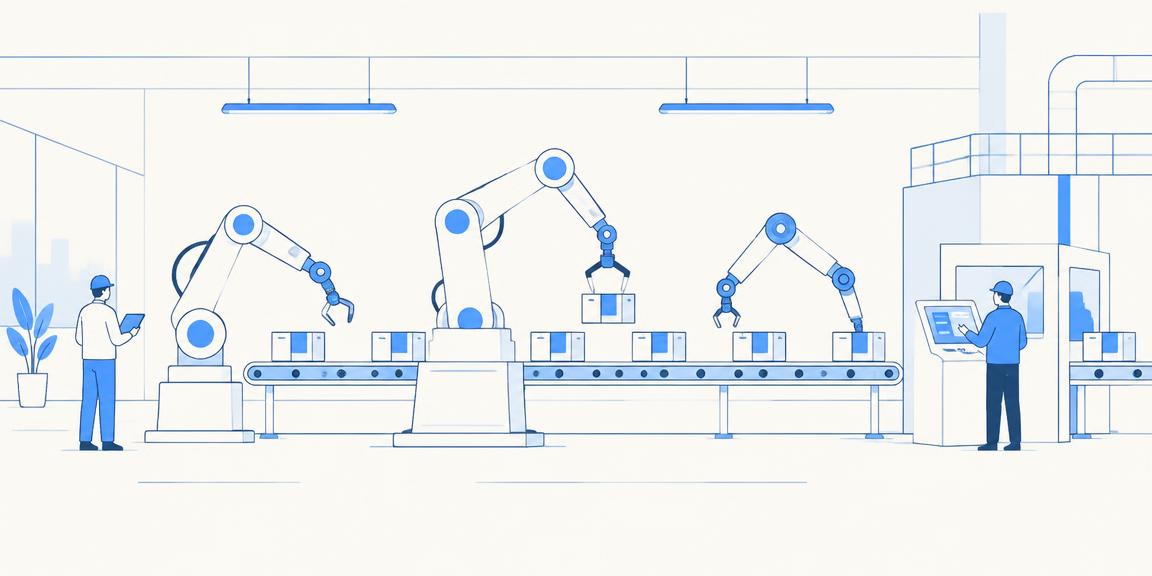
The machines already produce the data. Almost nobody uses it.
Modernize plants and devices with software that controls, monitors, and optimizes.
Where the
sector stands.
Modern industrial equipment is instrumented far beyond what most plants take advantage of. Sensors, PLCs, and controllers emit continuous telemetry that, in the majority of facilities, is read locally, displayed on a panel, and then discarded. The information needed to prevent downtime is generated and thrown away every shift.
Meanwhile the operational layer above the floor — scheduling, quality, maintenance, traceability — frequently still runs on paper travelers, whiteboards, and Excel. The opportunity in manufacturing is rarely a new machine. It is connecting the machines that are already there to software that acts on what they say.
What technology is changing right now.
The forces reshaping this industry — and why they turn into engineering problems.
Edge computing made real-time practical
Processing telemetry at the plant instead of shipping everything to the cloud removed the latency and bandwidth objections that stalled industrial IoT for years.
Predictive maintenance replaced fixed schedules
Vibration, temperature, and cycle data can indicate failure before it happens. The value is not the model — it is having the data pipeline and the maintenance workflow to act on it.
Traceability became a requirement
Customers and regulators increasingly want lot-level genealogy: what went into this unit, which machine ran it, who signed off. That is a data architecture problem.
OT and IT finally converged
Plant floor networks used to be isolated. Now they are connected — which delivers enormous visibility and introduces a security surface that must be designed deliberately.
Where it breaks today
- ▲Machine data trapped on local HMIs and never stored
- ▲Production schedules maintained on a whiteboard or spreadsheet
- ▲Quality checks recorded on paper and typed in days later
- ▲Downtime causes debated from memory instead of measured
- ▲No lot-level traceability when a customer asks for it
Systems that fix it
Machine connectivity and telemetry pipelines
PLC, OPC UA, Modbus, and sensor integration into durable, queryable time-series storage — the foundation for everything else.
MES and production software
Work orders, routing, scheduling, labor tracking, scrap, and yield — digitized in tools built for people wearing gloves on a plant floor.
Quality and traceability systems
Digital inspection, non-conformance handling, and full lot genealogy from raw material through finished unit.
OEE and downtime analytics
Availability, performance, and quality tracked automatically, with downtime reasons captured at the moment they occur rather than reconstructed later.
How we engineer here
Interfaces are designed for gloves, glare, noise, and speed. Large targets, minimal typing, obvious state.
Production cannot stop because an internet link dropped. Critical paths run locally and sync when connectivity returns.
Connecting plant equipment is done with network segmentation, read-only defaults where appropriate, and explicit control boundaries.
Industrial equipment speaks a dozen protocols of varying age. Integration work is inspection-first, never assumption-first.
The language of the sector
Plain-English definitions, so nobody has to pretend they know what an acronym means.
- PLC
- Programmable Logic Controller — the industrial computer that directly controls machinery on a plant floor.
- MES
- Manufacturing Execution System — software managing production between the ERP and the machines: work orders, routing, and shop-floor tracking.
- OEE
- Overall Equipment Effectiveness — a standard measure combining availability, performance, and quality into one number.
- OPC UA
- A vendor-neutral industrial communication standard used to read data from and write commands to modern equipment.
Straight answers.
Our equipment is old. Can it still be connected?
Usually yes. Older machines can often be read through their controller, a retrofit sensor, or a protocol gateway. We assess before promising.
Will connecting machines put our plant at risk?
Not if it is designed properly. We default to segmented networks and read-only data collection unless control is explicitly in scope.
Do we need to replace our ERP?
No. MES and shop-floor systems are typically built alongside an ERP and integrated with it.
Running one of these
operations?
Describe your setup to our AI Strategist and get an architecture sketch back in seconds — or go straight to a human.